Member Reports, continued:
From Bob Crelin:
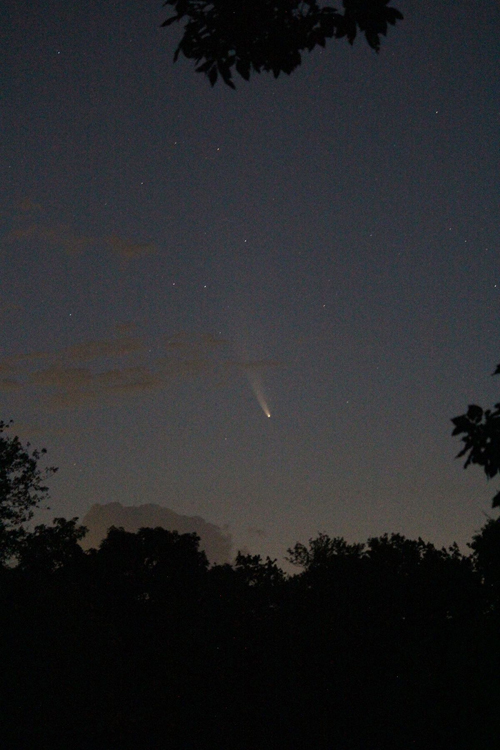
Bob got an early start on Comet NEOWISE, and he was able to catch it when it was still in the morning sky on July 14. He used a digital camera with a 55-250 mm zoom lens, ISO 6400, and exposures between .5 and 2 seconds.
From John Pancoast:
(Editor’s note: John was an active member of ASNH until he moved to the Washington DC area a few years ago. He still has many friends here who will enjoy reading about his progress in astrophotography.)
My astrophotographer’s journey over the past year has focused on trying to get better at deep sky photography. It’s hard from my apartment here in Washington, DC with no back yard to practice in. I do have access to a handful of dark sites through NOVAC, the club I joined here in DC. Still, it seems i am taking 2 steps forward and always suffer one step backward between visits to dark skies.
Last summer, at the RAC’s Summer Star Party in western Massachusetts, I started imaging the Western Veil. It’s large enough to fill up the field of view of my medium length refractor, but faint enough to test my beginner’s abilities. At the time, I had just started capturing images with Backyard EOS, which I really liked. For some reason, still unknown, my Canon camera stopped communicating with the computer that week, and I took it as a sign that this was the time finally to get a cooled astronomy camera. That led to learning to use new capture software (N.I.N.A.) and many other challenges in the months since. I think I have been out taking images of the Western Veil 4 or 5 times, with and without narrowband filters, often bedeviled by erratic guiding and, of course, poor seeing. The best I have been able to do is this image compiled from two sessions last month at Cherry Springs.
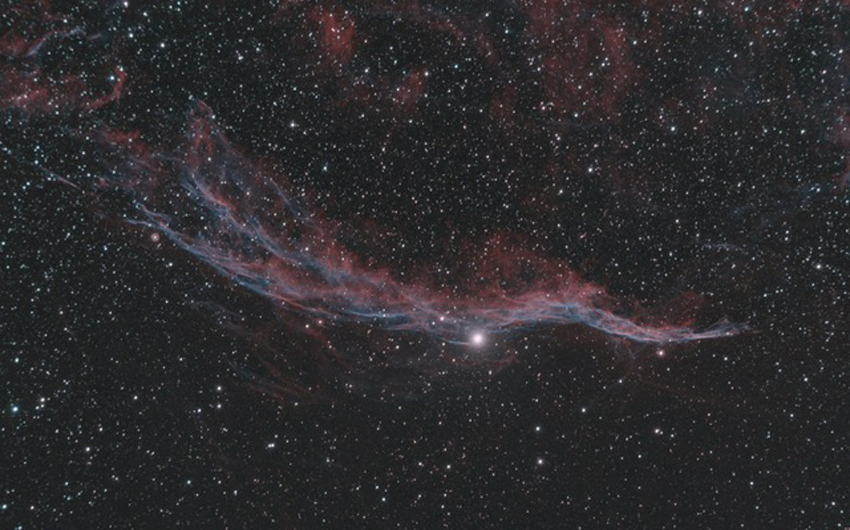
This image represents 3 hours and 40 minutes total time with the Optolong duo narrowband filter, which captures the H-alpha and OIII emission lines in the supernova remnant. The image scale with the William Optics 110mm /5.9 telescope and ZWO cooled OSC camera’s 4.9 micron pixels means that my images are under sampled by half. (Best not to zoom in too much!) However, I tell myself that I will invest in upgrades only when my capability is actually hindered by the item in question. I did buy a TV 2X Powermate that will solve this and also let me image smaller objects this fall.
It’s a pleasure sharing this with you and my friends in ASNH. I hope you are all getting by safely and with your health intact.