Observing Reports
By Michael Amato
Monday, December 30, 2024. The second new Moon or the new black Moon will occur tonight. The second full Moon in any month is often called the Blue Moon while the second new Moon of any month is called the Black Moon. I just read about this and I found it very interesting. I would love to go outside to view the new Black Moon, but alas all new Moons are invisible.
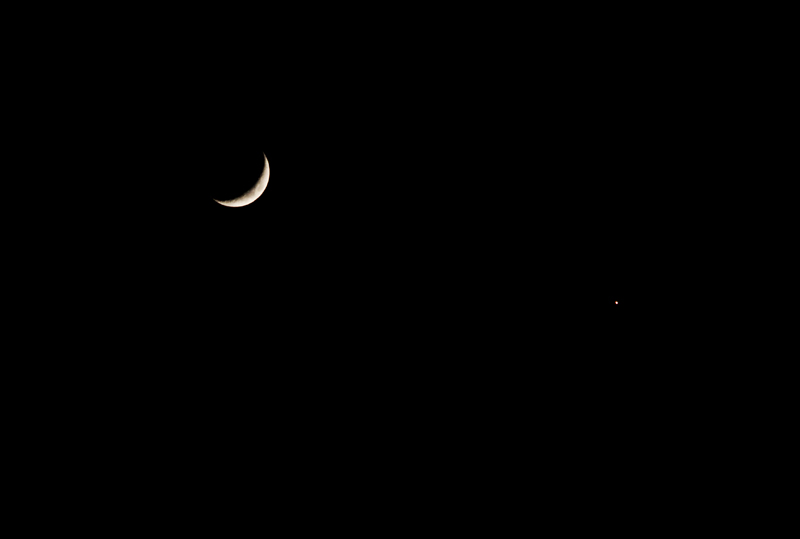
Friday, January 3, 2025. Four of us enjoyed the close encounter of Venus and the Moon. My friend Rose watched it from her house, my co-worker Ray and I watched it from Sports Haven where I work part time, and my brother Anthony watched and imaged the close encounter of Venus and the Moon. In this image by him, Venus can be seen to the lower left of the Moon. All four of us agreed it was a beautiful sight. The new year is off to a good start.
Saturday, January 11, 2025. After I left my part time job, I decided to try to see four naked eye planets and the Moon all at once looking west to east. I spotted Venus first high up the western sky as it was starting to get dark out. Just above and to the left was Saturn which is inching its way to Friday and Saturday’s conjunction with Venus. I then looked almost overhead to see bright Jupiter with the waxing gibbous Moon east of Jupiter. To see Mars, I had to reposition myself in the employee lot and there it was, the angry red planet Mars. What an interesting way to end the workday.
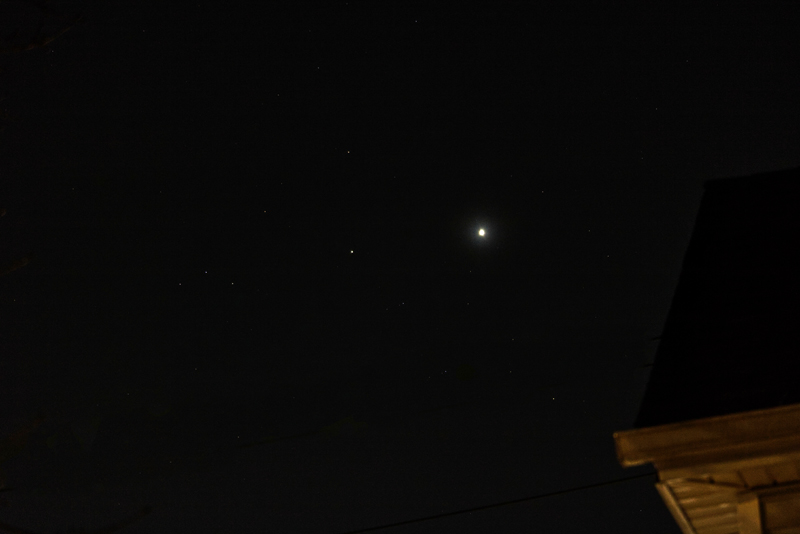
Friday, January 17, 2025. I enjoyed the conjunction of Venus and Saturn from the parking lot at my part time job. Venus and Saturn looked good together with just my naked eyes but when I looked at them with my 10×50 binoculars, I was blown away! Anthony and my friend Joe watched it from Joe’s house and Anthony imaged this with our Uninstellar telescope. Saturn is on the observer’s left and it was much dimmer. After observing the Moon-Mars occultation, this was icing on the cake.
Monday, January 20, 2025. When halftime came during the Ohio State Notre Dame football game, I stepped out onto my deck to check out the night sky. What I discovered was how black the sky was in my very light polluted area. The Sunday night mini snowstorm had made the skies completely dark which occasionally happens when a hurricane, tropical storm or a Nor’easter hits us. When I saw how bright the Orion constellation looked, I bundled up and took out my 5.1-inch Short Tube Newtonian Richfield Scope so I could examine the nebulosity throughout the whole constellation. With my Barlow lens, I had about 40 power. I first looked at the belt stars and sure enough the “haze” around them was quite pronounced. The Orion Nebula was more outstanding than it usually is, but the real deal was when I started to look at the fainter stars, because I was able to see nebulosity around them also! Before I went inside to watch the second half, I noticed a very clear patch of ice on my deck railing so after the third quarter ended, I came back out to examine the snow and this clear patch with my 60-power field microscope. The snow under my microscope looked like clear small crystals even though the snow was white. When I examined the clear ice, I was able to find about seven microscopic water drops trapped inside the clear ice. Thanks to this snow event, I was able to enjoy some science with my telescope and microscope.
Monday, January 27, 2025. This morning at 10:22 am, a 3.8 magnitude earthquake hit just off the southern Maine coastline. I was in my condo at that time, but I felt nothing and I heard no creaking. I checked my detector and all the balls stayed on the stems. I also checked my pictures hanging on my wall because that is one of the questions asked in the earthquake report I fill out. Sure enough, one of my pictures was askew and this was the first time ever one of my pictures was ever affected by an eastern earthquake. Even though the results are always mixed, I still enjoy trying to track these earthquakes. This type of radio astronomy is always very interesting.
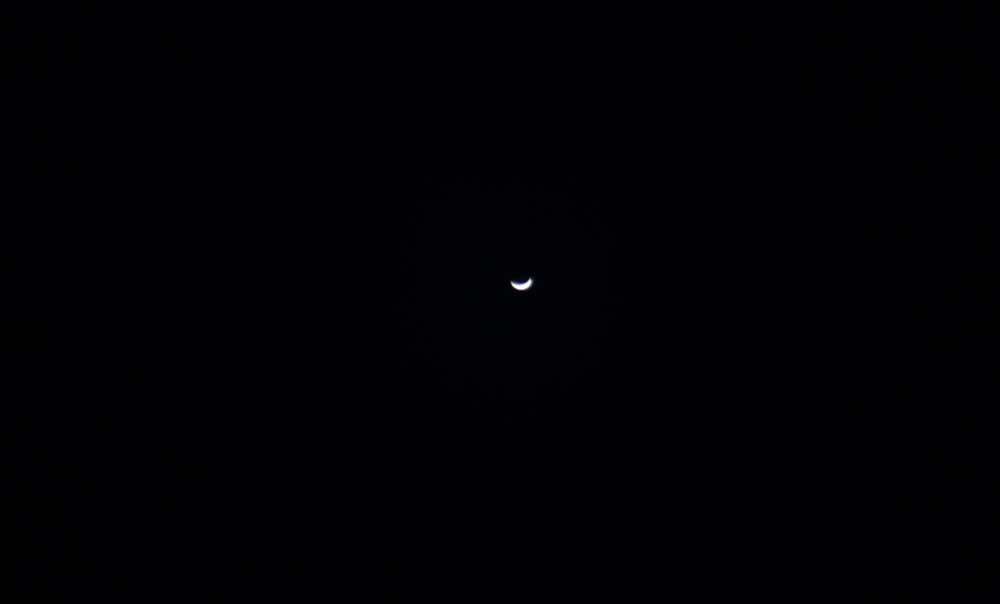
Monday, February 24, 2025. When Anthony and I were discussing observing the crescent Venus, I suggested he take an image of Venus with just his digital camera with the zoom lens. The image came out looking like a miniature crescent Moon. Now onto the total lunar eclipse.
Monday, March 3, 20205. I was observing the lower part of Canis Major well below Sirius when I came across a group of about 15 or 20 stars packed loosely together like they belong together with my 5.1′ Richfield Telescope. It was hard for me to tell if they were not related to each other or part of a loose open cluster. After looking it up, I realized I was looking at the loosely packed open cluster NGC 2354. It has many stars in it but with my Richfield scope I had to satisfy myself with seeing 15-20 spread-out stars. After 15 minutes of freezing, I had to retreat back to my house. It was a good show for me.
Saturday, March 8, 2025. Anthony, our friend Ray, and I watched Venus and Mercury fairly close to each other in the western sky. Venus was dazzling as usual while Mercury to the lower left of Venus was also pretty bright itself. In fact, Mercury was quite easy to see with our naked eyes. As a bonus, we looked straight up at the Moon-Mars close encounter. They were just 1.7 degrees apart. It was a nice astronomical double-header for us to view.
Saturday, March 29, 2025. I got up to try and see the partial solar eclipse. The middle part of the Sun briefly broke through the clouds by about 7:00 am and I did glimpse the shading on the Sun’s right side. Of course, only a very small area was eclipsed because the eclipse ended about 10 minutes later. Next year’s partial solar eclipse will be in August and it will be in the middle of the afternoon.