Observing Reports
By Michael Amato
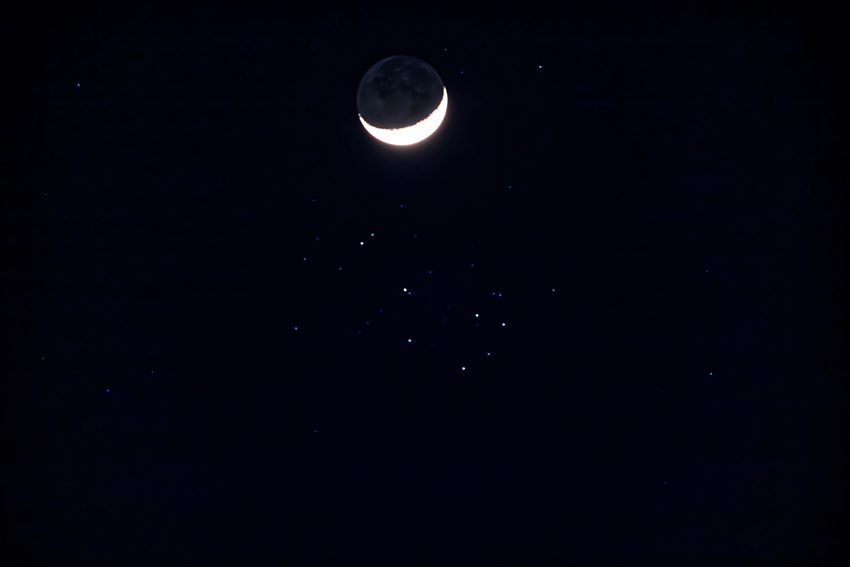
On Tuesday evening, April 1, four of us, Ray in Ansonia, Anthony in West Haven, Rose in New Haven and I in West Haven enjoyed looking at the close encounter between the crescent Moon and the Pleaides open cluster in Taurus. We had to use binoculars to see this conjunction clearly and I must say it was a beautiful sight for all of us. My brother Anthony imaged this great sight from his backyard and the image is below. I was still able to see that the stars were blue through my 10×50 binoculars. As a bonus, Jupiter was nearby also. All four of us agreed it was a nice evening of astronomy.
On Sunday evening, April 13, I was able to observe the Moon on the day after the full Moon. On this evening, the Moon was at its farthest point away from the Earth on its orbital journey around our planet. I have observed full Moons almost my entire life so I can easily tell the difference between the sizes of the super Moon and the micro Moon. This past Moon really looked small to me and when I observed it in my Richfield telescope, I was able to really notice the size difference. The entire Moon fits completely into the field of view and this allows me to notice the size differences of each full Moon. The difference in size of a super Moon and micro Moon in my scope is dramatic. If you start viewing each full Moon, even with your naked eye, you will be able to easily see the size difference in full Moon sizes. This is another reason to love astronomy.
On Friday morning, April 25, before dawn, Anthony and I got up early to try to see the crescent Moon with Venus and Saturn. First Venus rose and it was very bright. Next the crescent Moon came up on its side here in the northeast and we saw the beginning of a sideways smiley face. By the time Saturn rose above the obstacles, it was too bright to see the ringed planet. The result was that we observed 2/3rds of the smiley face. Venus and the Moon were about three or four degrees apart. It was still worth getting up to see what we were able to see.
On the evening of April 28, Anthony imaged the Coma Cluster with his digital camera while we did some casual astronomy. I must say it came out pretty nice. We also looked at the Northern Crown to see if expected nova had occurred yet. It didn’t. I’m beginning to think this might not happen at all. I’ll continue watching the Northern Crown for the nova.
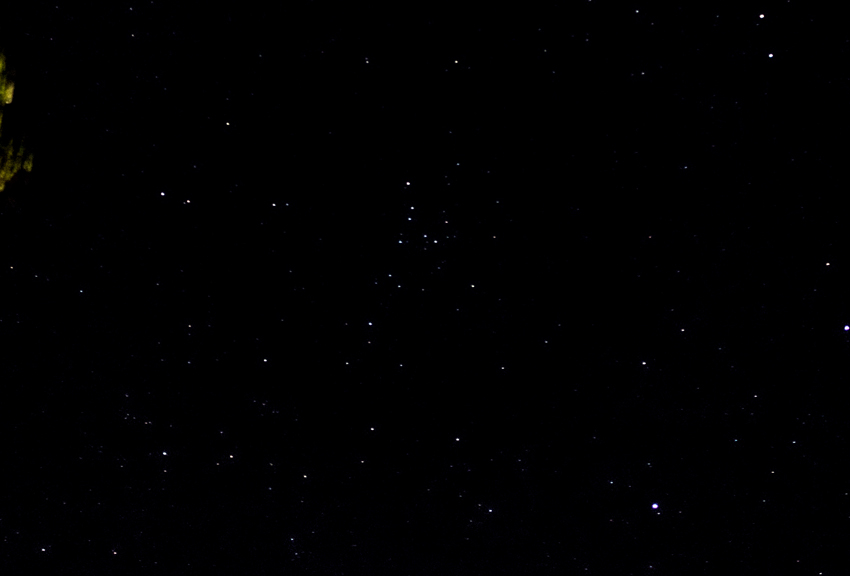
On the evening of June 4, I turned my 5″ Short Tube Richfield Newtonian toward the constellation Lyra to try to observe the sparse open cluster Stephenson 1. Once I arrived at the cluster, I spotted the two fairly bright foreground stars that are in front of the cluster. The cluster was large with just about 15 or so stars that I could see. They were faint but they looked nice. This open cluster is also supposed to be a nice view with binoculars so that is another way to observe this cluster. Also, on June 1, I observed the close encounter of the waxing crescent Moon and Mars which was 1.4 degrees away from the Moon. I used my 10×50 binoculars for that observation. It was two nice evenings of astronomy.
—
By Chris Predom
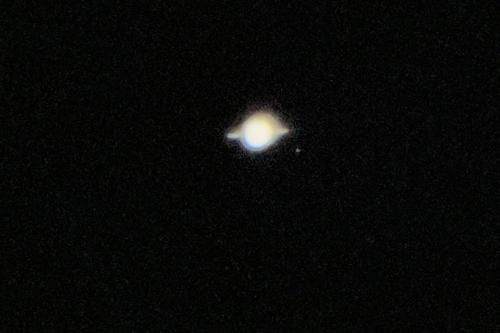
On June 16, I woke up at 3 am to try to watch the shadow of Titan pass over Saturn. It was somewhat clear. I could visually see Saturn and our Moon. I took out the Coulter Dob and got Saturn in view. Below is one image of Saturn and Titan. I had a good image of Saturn until 5 minutes before the event when it started getting washed out. I looked up. The Moon was covered by clouds and Saturn was almost entirely covered. For a few minutes Saturn came in and out of view, but at the start of the event, it was gone, completely clouded over. I am hoping the next event on July 2 will be better.